I saw the 4 Gb VM had over 3 Gb free after the work of my last post and some additional work editing the paths of the disabled projects to project_name_DISABLED, ensuring processes wouldn’t start for them even if something tried to. Though I haven’t checked on the PostgreSQL cluster yet, it seemed like there should have been enough memory so I proceeded with resizing the VM.
After resizing, I saw an interesting change in the available memory bytes. There was an initial bumpy thing then a drastic, linear decrease for a while (40 minutes or so), after which available memory continued to decrease somewhat at a slower rate and overnight stabilized at around ~340 MiB free. I am not exactly sure about the graph where the drastic decrease happens. Linux boots and starts using free memory to cache disk reads. If the resize involves restarting the VM, the RAM of the 4 Gb machine is lost, and after boot it builds the cache memory starting from 0. Maybe what it’s showing is a sum of memory while the 4 Gb VM deallocates and the 1 Gb VM pops into existence. Chat disagrees with that explanation so take it with a grain of salt but to me it seems consistent with the graph. The later slower decrease and stabilization are surely the processes continuing to warm up.
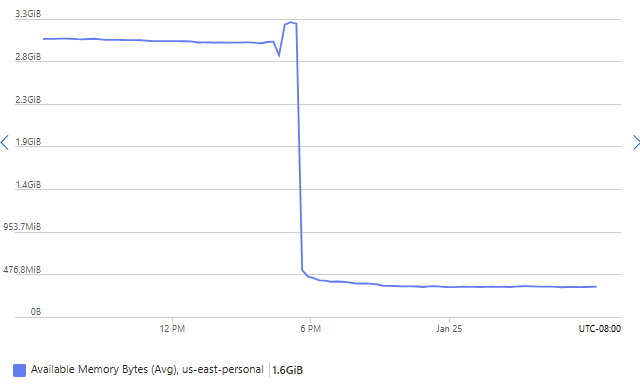
My experience with these 2 VM sizes (B-series v2 “B2pts_v2” with the same vCPUs (2), data disks (4), and max read/write speed (3750 IOPS) but either 1GiB or 4GiB RAM–which I’ve been calling 1 or 4 Gb) was that when the only app on the machine was Anki Books (Ruby on Rails), it could just barely run on the 1 Gb RAM machine. The Ruby jobs which create Anki deck package files would cause it to fall over, especially the job to find_each iterate and make every Anki deck package file. But sometimes the VM was falling over at random times without me starting those jobs. So with Anki Books and its app server Passenger using memory ruled out now, this was more a test of if it could handle my 2 relatively simpler Razor Pages apps, and so far it looks good.